TxSSC
School Behavioral Threat Assessment Toolkit
3.0 What Threat Assessment Is and What It Is Not
To create and implement the threat assessment process in your school, it is important to have a clear understanding of its purpose, capabilities, and limitations, in other words, knowing what it is and what it is not.
| Threat Assessment IS: | Threat Assessment IS NOT: |
|---|---|
| A fact-based, investigative approach to determine how likely a person is to carry out a threat of violence. (Safe School Initiative Study, 2002) | A simple checklist of warning signs or red flags used to remove a student from school. |
| A means to identify, assess, and manage individuals who are at risk for violence against themselves or others. | A means to label a student as a troublemaker and enact consequences. |
| A way to identify someone who has the potential for violence in many forms - self-harm, assault, risk taking behaviors, suicide, substance abuse, and other aggressive or dangerous behaviors. | A means to find “the next school shooter.” |
Threat Assessment IS a Systematic Process
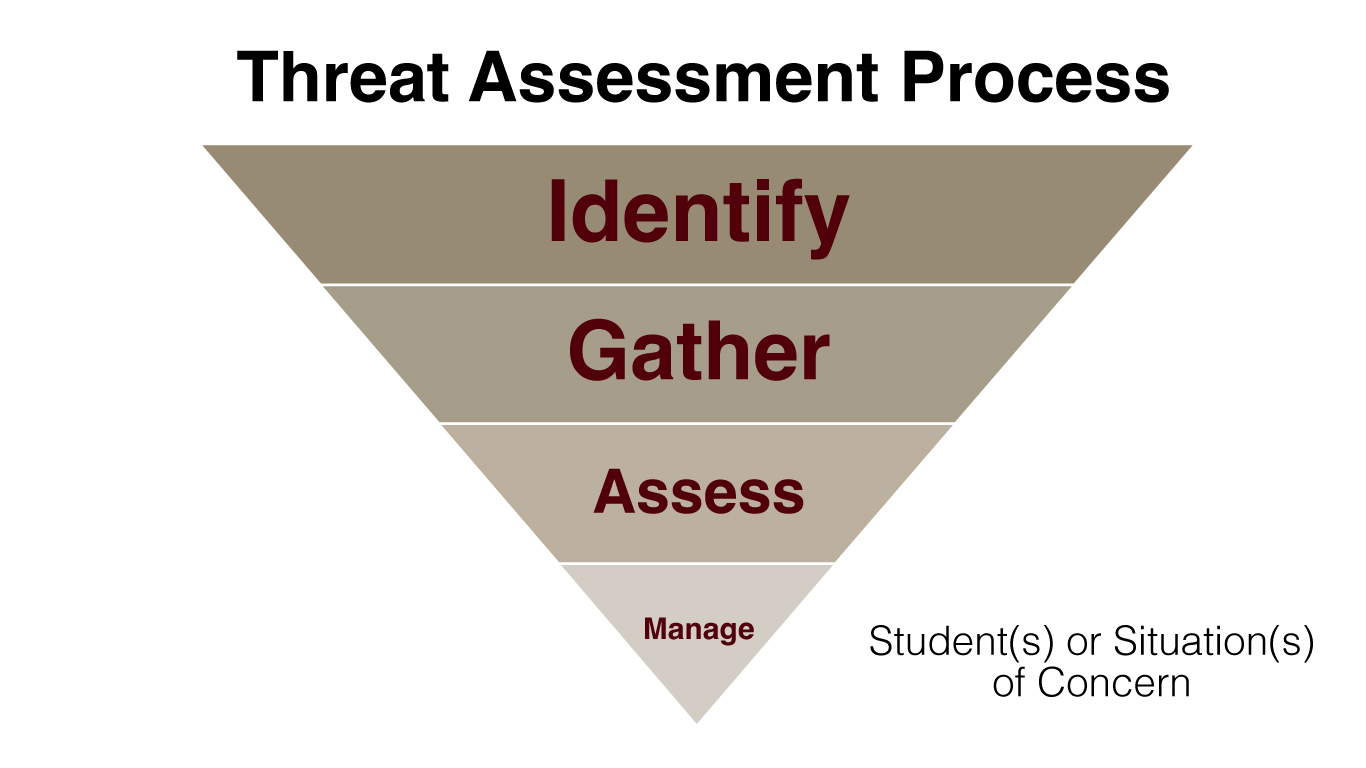
Threat assessment is a fact-based, systematic process designed to IDENTIFY, GATHER, ASSESS, and MANAGE potentially dangerous or violent situations. An effective threat assessment program uses this structured approach to distinguish between an individual who MAKES a threat and an individual who POSES a threat, including those who engage in concerning behaviors that may indicate a need for intervention.
- Identify the student(s) of concern or the situation(s) that has raised concerns about potential violence.
- Gather additional relevant information about the student(s) of concern or the situation(s).
Note: The focus of threat assessment is to understand the situation and how best to mitigate safety concerns. It is not the same as a criminal or disciplinary investigative process. - Assess the student(s) of concern or the situation(s) based on the totality of the information that is reasonably available to determine whether the student or situation poses a threat of violence.
- Manage the student(s) of concern or the situation(s) by implementing an intervention, supervision, or monitoring plan to prevent harm where possible and to reduce or mitigate impact of the situation.
Threatening and other disturbing behavior can come in a variety of forms. A threat may be:
- Expressed or communicated verbally, behaviorally, visually, in writing, electronically, or through other means.
- Expressed directly or indirectly.
- Issued by someone known or unknown to the target.
Threat Assessment teams and programs are designed to address any behavior or communication that raises concern that a person or situation may pose a danger to the safety of the school, campus, or workplace.
Now that we’ve briefly examined what threat assessment is, let’s identify what it is not. Threat assessment is not a simple checklist of warning signs or red flags that an administrator or school counselor completes based on a single threat or incident. It examines the whole picture, not just an isolated event. The use of threat assessment principles is not a means to kick students out of school or label them as troublemakers, but rather to craft a plan for effectively intervening and managing the individual. Importantly, threat assessment is not about “finding the next school shooter.” It is a broader process that helps schools recognize and address a wide range of concerning or potentially dangerous behaviors, ensuring that students and the school community receive appropriate support and intervention.
Threat assessment is NOT profiling
Profiling involves making generalizations about an individual based on their perceived similarity to high-risk groups; it is an assumption-driven process.
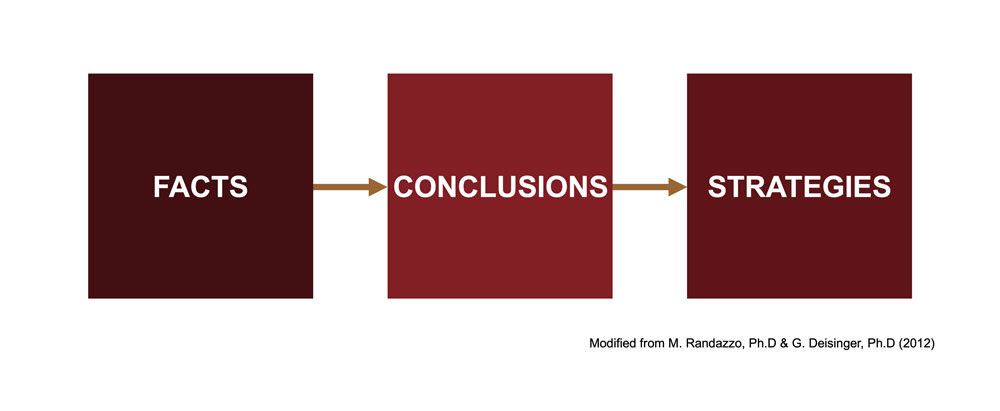
Threat assessment, unlike profiling, involves a careful, individualized review of a person of concern within the context of a specific situation and moment in time. It is fact-based, deductive, and dynamic, guiding interventions that match the concerning behavior and nature of the threat.
It is also important to understand the distinction between a vulnerability assessment and a threat assessment. A vulnerability assessment focuses on things, not people. It examines the facility, daily operations, policies, and procedures, to identify physical or systematic weaknesses that could create risk because it evaluates the environment and infrastructure, a vulnerability assessment is scheduled and conducted periodically to review the security of the physical space and operational practices.
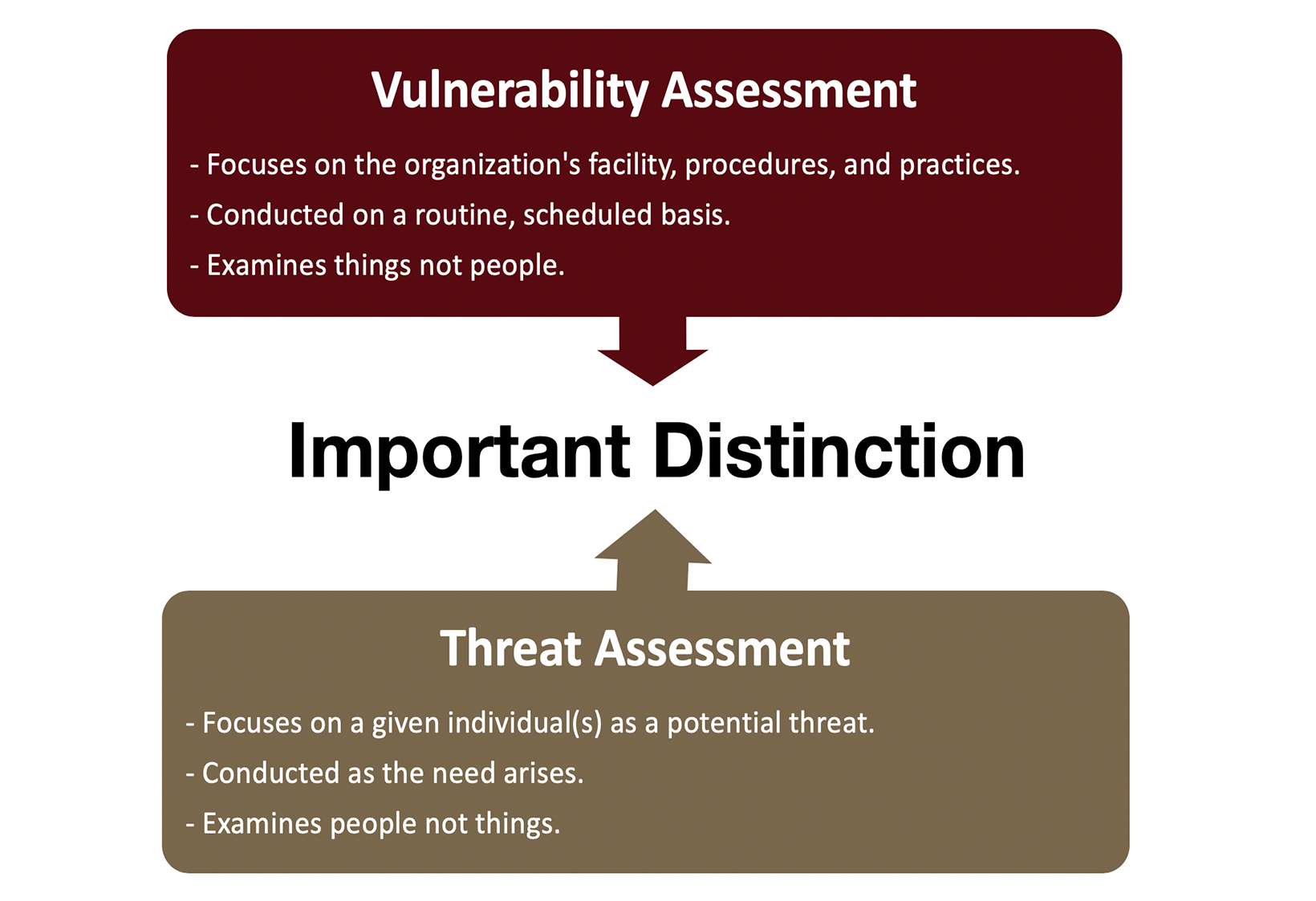
A threat assessment, on the other hand, is centered on people, specifically individuals of concern and their behaviors. Threat assessment cannot be scheduled; they must be initiated whenever a threat is reported or when concerning behavior is observed. This process focuses on a specific individual, the threats they have made or may pose, and the development of a plan for management and intervention.
While vulnerability assessments and threat assessment processes serve different purposes and use different methods, both are essential to maintaining a safe school environment.
More information on safety and security audits can be found in the Texas School Safety Center’s School Safety and Security Audit Toolkit.
Reference
Virginia Department of Criminal Justice Services. (2025.) Threat Assessment and Management in Virginia Public Schools: Model Policies, Procedures, and Guidelines. Sixth Edition.
www.dcjs.virginia.gov/sites/dcjs.virginia.gov/files/law-enforcement/files/vcscs/K-12_Threat_Assessment_Management_2025.pdf