TxSSC
Laws are necessary in order to protect you, but legal language can be difficult and boring to read. This section summarizes Texas’ laws that apply to bullying, harassment, sexting, intimate image abuse, sextortion, and child sexual abuse material (child pornography.)
Keep in Mind:
- New laws are passed all the time.
- Ignorance of the law, in other words saying: “I didn’t know,” is never a defense.
- Texas district attorneys can add charges if necessary.
- Some adults may not know about apps to hide files, but police do and can access them.
David’s Law24
Texas lawmakers got to work creating stricter bullying laws after David Molak, age 16, died by suicide in 2016 in San Antonio, after he endured relentless cyberbullying. The bill passed with a unanimous vote, and in June 2017 Governor Greg Abbott signed David’s Law into law allowing school districts, police, and prosecutors to fight cyberbullying on multiple fronts, with expanded definitions and tools.
Watch the video below and ask yourself:
- Why did this law need to be passed?
Video | 1:10
Texas Bullying defined:
- Can consist of all forms of communication.25
- Includes off-campus actions and communications that interfere with a student’s educational opportunities, or significantly disrupts the school environment.26
- No longer needs to be a pattern, it can be a single significant act.27
- Schools must have a bullying policy, anonymous and regular reporting system, and protect staff and students who report bullying.28
- Authorities may be notified, and parents or guardians must be notified.29
- Allows a court to issue a temporary restraining order, temporary injunction, or permanent injunction to prevent any further cyberbullying by the guilty minor or the parent or guardian of the guilty minor may be compelled to take reasonable actions to cause the minor under their care to cease engaging in cyberbullying.30
- Allows transfer of students to another school when necessary.31
- All school counselors, teachers, nurses, administrators, and other staff, as well as law enforcement officers and social workers who regularly interact with students must receive training in suicide, bullying, and harassment.32
Texas Sexting Laws Involving Young People
Sexting is a crime in Texas even if no adult is involved. Under Texas Penal Code Section 43.261, it is a crime for a minor to “intentionally or knowingly” send another minor an obscene photo/video or a photo/video of a minor engaging in sexual conduct, if they know it was a minor. First-time offenses are punishable by a Class C misdemeanor, but the statute indicates that under some circumstances a first-time offender can be charged with a Class B misdemeanor.
In 2019, the Texas Legislature added Penal Code 21.19 which states that a Class C misdemeanor is committed by a person if they knowingly transmit electronic visual material that depicts any person engaging in sexual conduct or with the person’s intimate parts exposed that is not sent at the request of or with the express consent of the recipient. This applies to all electronic platforms such as e-mail, texts, apps, and social media. These laws exist to protect you. Do not allow them to discourage you from involving law enforcement if you are a victim.
Texas Intimate Image Abuse Law
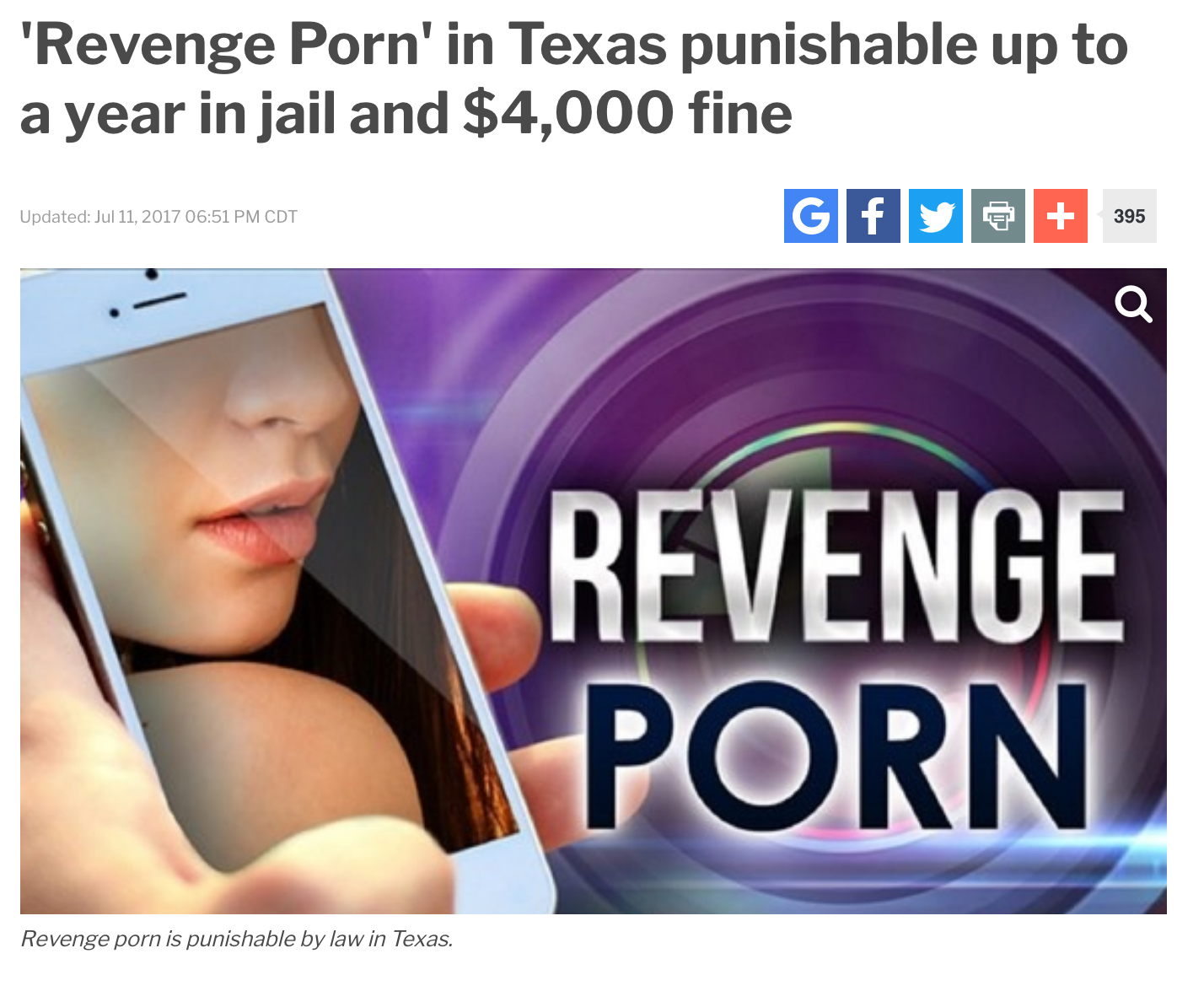
In 2015, the Texas Legislature passed Texas Penal Code Section 21.16, called the “Relationship Privacy Act,” which makes it a crime to share or promote someone’s private sexual images without their consent. In 2017 the law was updated, increasing the penalty to a state jail felony when someone reveals or discloses intimate images or videos of another person without permission. “Visual material” now includes digital files of images or videos that can be displayed on a computer or phone screen. Just because someone took a private photo or video of themselves and sent it to a partner doesn’t mean they gave consent for it to be posted, shared, or shown to anyone else.
Invasive Visual Recording Law
It is now a felony under Texas Penal Code 21.15 to photograph, videotape, or otherwise record someone’s “intimate areas” in a place where they have a reasonable expectation of privacy, like a bathroom or changing room, without their consent. We should all feel safe being able to go to the bathroom without worrying that someone is recording us. This includes bathrooms and changing areas in schools. Consent is not implied, meaning you can’t put up a sign warning people that they are recorded in that area (bathroom, changing room, etc.)
Texas Sextortion Laws
Texas Penal Code 33.021 makes it a felony offense to solicit anyone under the age of 17 (a minor), or anyone the offender believes to be under the age of 17, online for sexual contact or have sexually explicit communication with a minor, or someone they believe to be a minor.
Texas Penal Code 33.07 states that if a person “uses the name or persona of another person” without that person’s consent and with the intent to harm, threaten, defraud, or intimidate the person, then he or she has committed a felony offense.
Texas Penal Code 21.18 says sexual coercion occurs if a person intentionally threatens by coercion or extortion, to commit certain acts defined in the Penal Code (trafficking, or various sexual assaults) threatens to obtain an act involving sexual conduct causing arousal or gratification or intimate visual material. This section applies to a threat regardless of how that threat is communicated, including a threat transmitted through e-mail or an Internet website, social media account, or chat room and a threat made by other electronic or technological means. Such action is a felony offense.
Texas Child Sexual Abuse Material Laws
In Texas, child pornography is now referred to as “Child Sexual Abuse Material.” Pornography is when an adult has given consent to be naked in a picture, video, or drawing, and is legal, because the adult gave consent. A child cannot give consent to be naked in a picture, video, or drawing, so this type of material is illegal. According to the Texas Office of the Attorney General, the age range of children most often targeted by child predators online is ages 10-17. They also found that 1 in 7 young people have experienced unwanted sexual solicitations online, and 1 in 3 have been exposed to unwanted sexual material online.
Texas Penal Code 43.26 states that it is a felony crime, up to the first degree, for an adult to knowingly or intentionally possess or access with the intent to view material that depicts a child under the age of 18 engaging in sexual conduct; this includes sexting with a minor.
Texas Artificial Intelligence (AI) Laws
Artificial Intelligence (AI) is like a type of computer program that can think and learn like a person. It can help people to talk, write, recognize pictures, play games, or make decisions.
For example, when you ask Alexa or Siri a question, that’s AI, or when Netflix or YouTube suggests videos you may like, that’s AI, too.
There are several Texas laws that address safety concerns about AI:
Texas Penal Code 21.165, often referred to in the media as the state’s “deepfake porn” law, makes it illegal to knowingly create or share sexually explicit Artificial Intelligence (AI) generated or computer-altered images or videos of a person without their consent. The law also makes it illegal to threaten to create or share such content to harm, control, or intimidate someone.
Texas Penal Code 43.325 creates a new state jail felony offense for the possession or promotion of obscene material that appears to depict a child younger than 18 years old, regardless of whether the depiction is of an actual child, cartoon, or animation, or an image created using an artificial intelligence application or other computer software.
This means it is a crime to have or share inappropriate or sexual pictures or videos that look like they show someone under 18, even if the image is a cartoon, animation, or made by a computer or AI. This means it doesn’t matter if the picture is real or fake, it is still against the law. Texas Business and Commerce Code Section 552.057 bans a person from developing or distributing an artificial intelligence system to produce or distribute sexually explicit deepfake images or videos, child sexual abuse material, or sexually explicit text-based conversations that impersonate or imitate children.
This means using AI to create or share sexual images, deepfakes, or videos of children is illegal. Deepfakes are videos, audio recordings, or images where a person’s face, voice, or body has been changed digitally using AI to make them appear real. Deepfakes can make it seem like someone said something they didn’t say or do something they didn’t do. It is often done for harmful reasons.
Texas Business and Commerce Code Section 552.052 prohibits the development or deployment of artificial intelligence to encourage a person to commit physical self-harm, suicide, harm to another person, or to engage in criminal activity.
In other words, using AI to encourage someone to harm themselves or others, or to do something criminal is a serious crime.
What Resources Are There to Help?
The National Center for Missing & Exploited Children operates the CyberTipline and Take It Down. Take It Down is a free service that can help you remove or stop the online sharing of nude, partially nude, or sexually explicit images or videos taken of you when you were under 18 years old. You can remain anonymous while using the service and you won’t have to send your images or videos to anyone.”
References
24David’s Law - Senate Bill 179
25Texas Education Code 37.0832(a)(1)(A)
26Texas Education Code 37.0832(a-1)(3)(A) and (B)
27Texas Education Code 37.0832(a)(1)(A)
28Texas Education Code 37.0832(c)
29Texas Education Code 37.0151(a) and Texas Education Code 37.0832(c)(4)
30Texas Civil Practice and Remedies Code 129A.002(b)