TxSSC
2022-2025 Charter Audit Report (CAR)
Findings on School Safety and Security in Texas Charter Districts
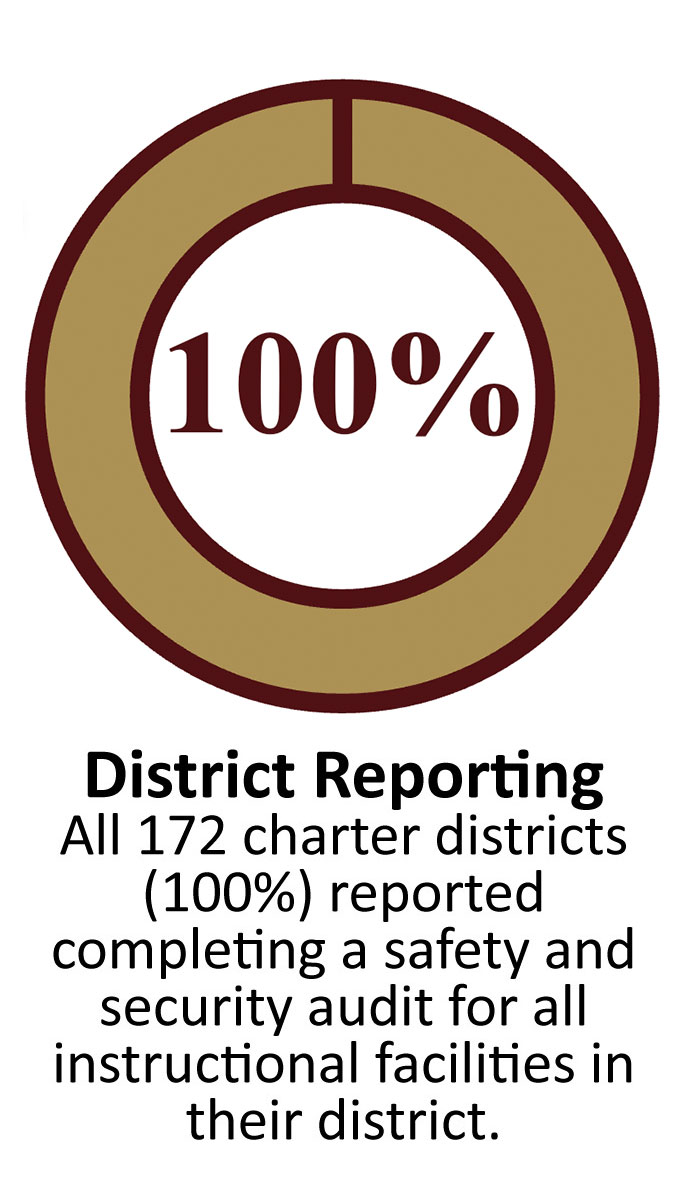
The purpose of the CAR is to provide key results of the safety and security audits completed by Texas open-enrollment charter districts (herein referred to as charter districts). The Texas Education Code (TEC) requires districts to complete safety and security audits of their facilities once every three years. A district, or a person included in the registry established by the Texas School Safety Center (TxSSC), must follow safety and security audit procedures developed by the TxSSC (TEC §37.108(b)). Audits are conducted with the aim of identifying hazards, threats, and vulnerabilities that might pose a danger to life or property and/or may interfere with a safe, secure, and healthy environment that is conducive to primary and secondary education.
The TxSSC developed a model safety and security audit toolkit for charter districts that provides guidelines for conducting audits (TEC §37.207(1)). The audit toolkit for the 2022-2025 audit cycle included step-by-step instructions and recommendations for conducting audits, including a comprehensive audit checklist. The TxSSC captured key results of the safety and security audits completed by all Texas charter districts. The data submitted by each charter district were then aggregated into a statewide report for the public and the Texas State Legislature (TEC §37.108(c); TEC §37.207(a)(3)).
“The purpose of the CAR is to provide key results of the safety and security audits completed by Texas public charter districts.”
Methodology
The CAR provides a summary of safety and security information for the reporting cycle September 1, 2022 through August 31, 2025. The report is comprised of self-reported data submitted by charter districts in Texas. The TxSSC is authorized by the Texas Legislature to determine the method used to collect the audit results, as well as the type of data necessary for collection. Data was collected via the CARtool, an online reporting mechanism developed by the TxSSC.
The CARtool was comprised of 11 sections containing single and multi-part questions pertaining to school safety. The 11 sections of the CARtool included: charter district contact information and district demographics, safety and security information, school safety and security committee, emergency management information, behavioral threat assessment, suicide prevention, and trauma-informed practices information, bullying prevention policies and procedures, active threat exercise, law enforcement and non-law enforcement security personnel, additional safety and security information, a signature page, and attestation. All data is self-reported by charter districts.
The CARtool was made available to districts to begin reporting audit results on April 15, 2025, and officially closed for reporting on September 15, 2025. In total, all 172 charter districts (N = 172) reported audit results via the CARtool, for a response rate of 100 percent.
Major Findings
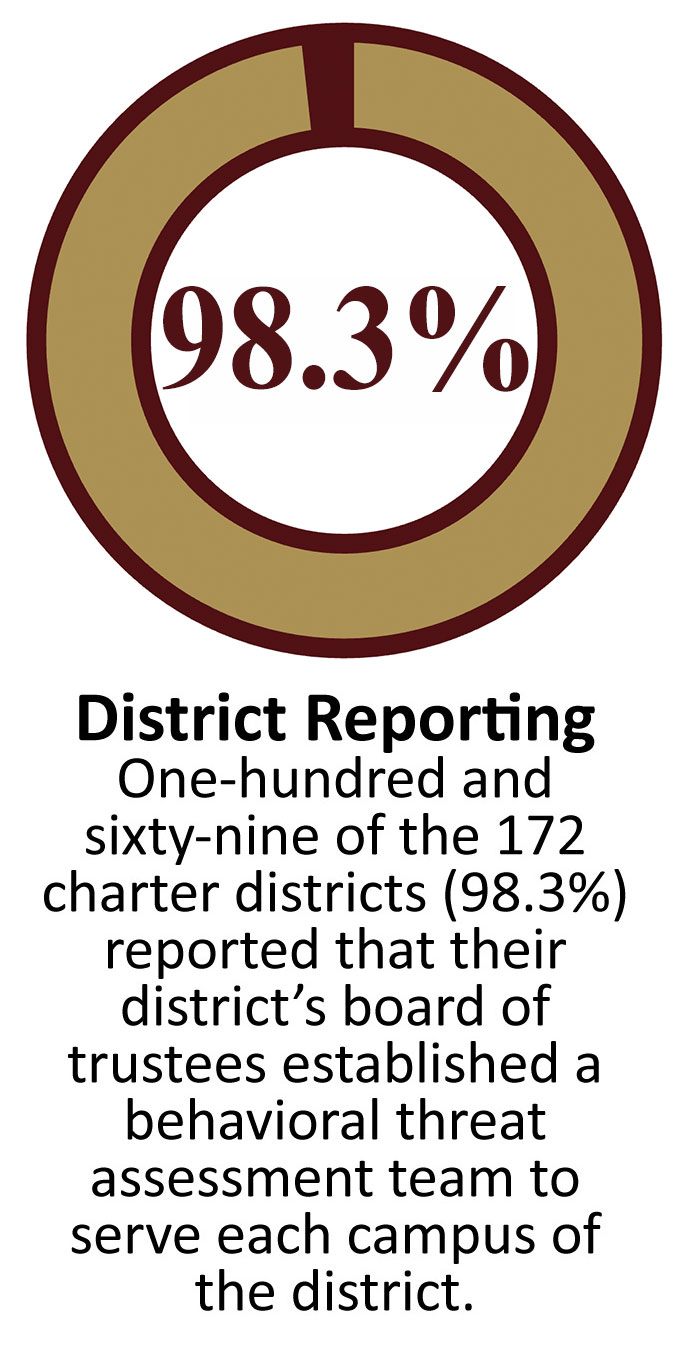
- The audit findings indicate 169 of the 172 (98.3%) charter districts reported establishing a school behavioral threat assessment team to serve each campus of the district.
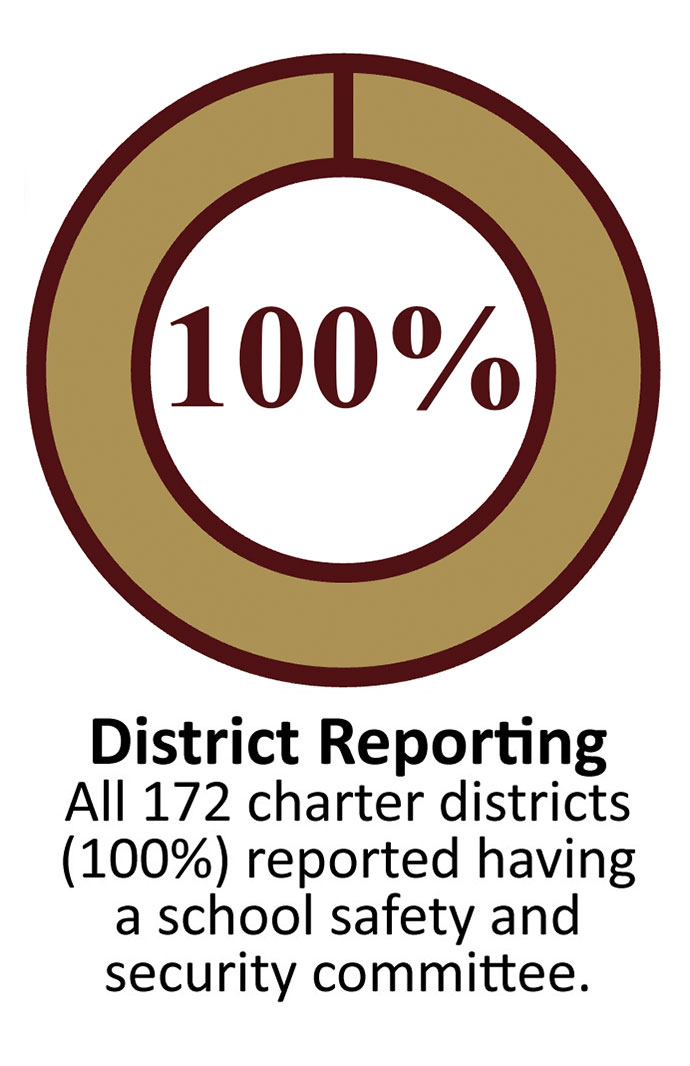
- The audit findings indicate 172 of the 172 (100%) charter districts reported having a school safety and security committee. Twenty-three of the 24 (95.8%) charter districts that reported operating on a year-round system or other alternative schedule and 143 of the 148 (96.6%) charter districts that reported operating on a standard schedule reported their school safety and security committee met in accordance with legislatively prescribed requirements.
- The audit findings indicate charter districts reported conducting the following drills at instructional facilities: 172 of the 172 (100%) reported conducting lockdown drills; 171 of the 172 (99.4%) reported conducting fire evacuation drills; 168 of the 172 (97.7%) reported conducting shelter-in-place for severe weather drills and evacuation drills; and 166 of the 172 (96.5%) reported conducting shelter-in-place for hazmat drills and secure drills. The audit findings also indicate charter districts reported conducting the following drills at non-instructional facilities: 56 of the 70 (80.0%) reported conducting evacuation drills; 54 of the 70 (77.1%) reported conducting fire evacuation drills, shelter-in-place for severe weather drills, and lockdown drills; 52 of the 70 (74.3%) reported conducting shelter-in-place for hazmat drills and secure drills.
- The audit findings indicate 168 of the 172 (97.7%) charter districts reported adopting and implementing a policy requiring the integration of trauma-informed practices in each school environment.
- The audit findings indicate 72 of the 172 (41.9%) charter districts reported conducting an active threat exercise, which are not required under TAC §103.1211(a)(b).
- The audit findings indicate 84 of the 172 (48.8%) charter districts reported having at least one armed security officer (e.g., school district peace officer, school resource officer, commissioned peace officer employed as security personnel) on each of their campuses. Of the 88 charter districts that reported not having at least one armed security officer present during regular school hours at each campus, 85 (96.6%) charter districts indicated their board of trustees claimed a good cause exception due to noncompliance of TEC §37.0814(a)(b) related to availability of funding or personnel who qualify to serve as security officers.
- The audit findings indicate 171 of the 172 (99.4%) charter districts reported providing the Department of Public Safety, local law enforcement agencies, and emergency first responders with an accurate map of each district campus and school building. The audit findings also indicate 171 of the 172 (99.4%) charter districts reported providing the opportunity to conduct a walk-through to local law enforcement agencies; 170 of the 172 (98.8%) to emergency first responders; and 169 of the 172 (98.3%) to the Department of Public Safety.
- The audit findings indicate 157 of the 172 (91.3%) charter districts reported adopting and implementing policy regarding the maintenance, administration, and disposal of opioid antagonists at each campus in the district that serves students in grades six through twelve.
Summary
The findings from the 2022-2025 audit cycle identified eight required actions and additional considerations intended to support charter districts in strengthening their safety and security efforts.
- Charter districts must establish School Behavioral Threat Assessment (SBTA) Teams.
- Charter districts should maintain a multi-disciplinary school safety and security committee that meets in accordance with legislatively prescribed requirements.
- Charter districts shall continue to conduct drills at all facilities.
- Charter districts must adopt and implement a policy requiring the integration of trauma-informed practices.
- Charter districts can benefit from conducting active threat exercises.
- Charter districts must work toward fulfilling the responsibility of having armed personnel on every campus.
- Charter districts must work closely with the Department of Public Safety, local law enforcement agencies, and emergency first responders to ensure that accurate campus maps are provided, and walk-through opportunities are available.
- Charter districts must implement a policy regarding the maintenance, administration, and disposal of opioid antagonists at each campus.
Refer to the full Summary of Key Findings on page 67 for details and resources pertaining to each recommendation.
The purpose of the CAR is to provide key results of the safety and security audits completed by Texas public charter districts.